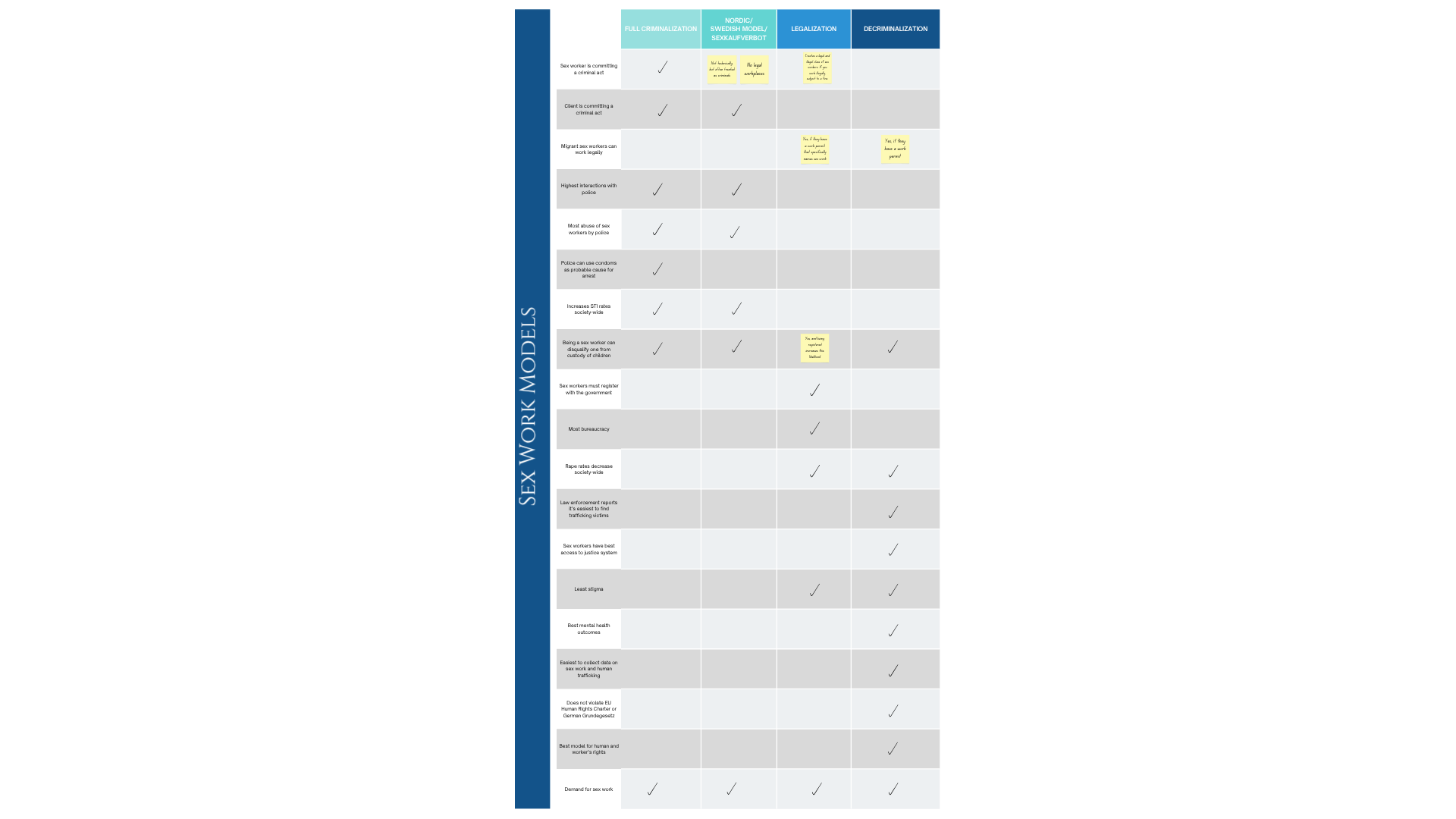
It is difficult to find places on the internet with a quick-and-digestible version of the arguments we use as sex workers’ rights activists. Here is my fact sheet, a graphic, and favorite resources.
Sex Work: Key Facts
Myth: “x% of prostitutes are coerced or forced.”
Truth: Choice of work is not a black-and-white issue and cannot be quantified.
Most need to work to survive. Therefore, most choices about work are, by nature, coerced. Freedom of choice, in absolute terms, could only exist for an independently wealthy person.
Many factors further complicate to what extent a sex worker chooses their profession, such as:
- Do they have children or other family to consider?
- What is their immigration status, and does it allow them access to other employment?
- If they are a marginalized person (due to race, ability, sexual orientation, gender, etc.), do they have equal employment opportunities in the society in which they live? Would they be paid equally to their white, cis-male counterparts?
Example: In most of human history, very few professions were open to women who wanted economic independence. This drove many women who wanted or needed to support themselves to sex work, even if it wasn’t their first choice of vocation.
According to the UN, human trafficking occurs when additional forms of coercion are present, such as:
- threats
- use of force/violence
- fraud
- deception
- abuse of power or of a position of vulnerability
BUT, it’s complicated: These forms of coercion are also prevalent among white, German women within legally operating sex work businesses in Germany, while, commonly, women in other countries often seek out migration agencies to get them out of their native land by any means necessary (e.g., to escape poverty or war).
Another (dramatic) example: Our research reveals narratives where women in concentration camps had a choice (not an absolute choice, but some degree of choice) between working in the camp brothels or other types of work, and some chose the camp brothels because survival in them was more likely than, for example, outdoor work in winter.
This means that each person arrives in sex work via a different path, with different degrees of choice. One statistic can never represent this reality, and most attempts to do so are disingenuous by nature.
Some insist that there is no such thing as a sex worker who is self-determined in their work. This is often underpinned by a narrative that any sex worker who says that she feels well in her work is too mentally ill to realize that all sex work is rape. To this argument, my response is usually: How do you explain my existence, then?
Myth: “Criminalization of sex work protects women.”
Truth: Criminalization—even buyer-side criminalization (Sexkaufverbot)—endangers sex workers. A workers-rights approach is the only way to decrease STI prevalence, coercion, exploitation, rape, and trauma.
- Criminalization is linked to increased violence and unsafe conditions
- It pre-empts any possibility of advocating for better working conditions
- The more sex workers must interact with police, the more trauma they experience, leading to decreased mental health and an increase in negative health outcomes, such as arrest-related PTSD self-medication via drug use (getting arrested isn’t good for anyone)
- In Germany, approximately 6,03% of sex trafficking victims are registered as sex workers with the government. Registration ¹ decreased trafficking
Myth: “Sex workers are a public health risk”
Truth: There is an equal prevalence of HIV among insured sex workers as in the general sexually active German population: 0.2%.
- Condom use is mandatory by law when offering sexual services
- If sex is your business and your body is your workplace, you are more likely to care for your sexual health. Giving a client an STI can end your career
- What people should worry about: uninsured sex workers and a lack of dedicated testing facilities with low barriers to entry (registration does not give SWs access to any additional health resources)
- Health panics over “superspreader” sex workers have been used as an excuse to adopt more restrictive policy for hundreds of years, from syphilis to HIV to Covid-19.
My top recommendation for understanding sex work and global health is the Lancet series on HIV and sex workers: https://www.thelancet.com/series-do/hiv-and-sex-workers
Myth: Decriminalization is dangerous because no one would be controlling STI transmission, coercion, and rape.
Truth: Statistically, decriminalization has the best outcomes for global health, the ability of law enforcement to find trafficking victims, and access to the justice system when clients are dangerous and bosses are coercive.
- The most impactful statistic in global sex work policy: Decrim was found to be the single most effective policy to decrease the spread of HIV worldwide (30% over 10 years). This is because, under criminalization, police use condoms as evidence that someone is a sex worker, causing sex workers not to carry condoms
- When France switched from decrim to the Nordic Model in 2016, income decreased and working conditions deteriorated. It caused a rebalancing of power in favor of the client in negotiations, a possible increase in pimping but certainly no decline, no appreciable change in the quantity of sex workers, and a massive increase in violence and risk of theft, assault, rape, and death. The ability of the sex worker to enforce condom use has declined from 92% to 65%, leading to an increase in HIV and syphilis. When the law was instated, France saw murders of 10 sex workers in 6 months.
- Under decrim, human sex trafficking and aggravated pimping remain illegal (of course). It does not pre-empt occupational safety laws (as exist in other industries)—it only removes the conditional nature of legal work (e.g., via registration)
- Every sex worker organization internationally advocates for decrim. It is unanimous
- When advocating for this policy, SWs are simply asking for the same consideration as guides all other feminist struggles: “My body, my choice.”
Myth: The registration requirement increases sex worker safety by controlling human trafficking.
Truth: The government now admits that the ProstituertenSchutzGesetz (current sex work law; ProstSchG) did NOT increase detection of trafficking. The registration requirement violates sex workers’ human rights.
- Both the EU Human Rights Charter and the German Grundgesetz guarantee a right to privacy. The Grundgesetz also guarantees a right to sexual and professional self-determination. Due to the registration requirement, data about the sexual practices of sex workers is not private. We do not have equal rights to privacy under this law.
- My personal attempts to challenge illegal exploitation in the contexts of legally operating sex-work businesses have failed, and most SWs assume authorities aren’t interested in helping
- Under National Socialism, a similar registration system existed and was later used to round up and deport “sexual deviants” to concentration camps
- Many sex workers don’t register for reasons of privacy, child custody, and “Berufsverbot” (e.g., if they wish to work as a teacher or police officer in addition or in future). This means that they are not allowed to work at the saf(er), indoor businesses (e.g., brothels) or with agencies that often have access to better clients.
My top recommendation to understand human trafficking is its chapter in:
De Haas, Hein. How migration really works: A factful guide to the most divisive issue in politics. Random House, 2023.
Myth: An expert commission has been empaneled to create a new sex work law based on evidence and proven best practice.
Fact: There are no sex workers on the so-called “expert commission,” repeating a mistake the German government has made for hundreds of years.
- Life as a sex worker is too far outside most peoples’ lived experience to be fully grasped by any layperson: No one can speak to sex workers and their needs except sex workers themselves
- Without our input, the dumb and harmful mistakes of history are likely to be repeated
- For example: Sex workers predicted the findings of the ProstSchG report that was recently published before the law was enacted. They were not listened to
- The lack of sex workers on the panel points to an ongoing assumption that sex workers are not experts in SW policy and are not competent to understand their own needs. Stigma is alive and well.
References and Further Reading
Albright, E., and D’Adamo, K. “Decreasing Human Trafficking Through Sex Work Decriminalization.” American Medical Association Journal of Ethics. 2017. 19(1).
Amnesty International. Experts Back Decriminalization as the Best Means to Enhance the Rights of Sex Workers. 2023. Amnesty.org.
Bachalova, Polina. How the Nordic Model in France Changed Everything for Sex Workers. Open Democracy. www.opendemocracy.net
Bremer, V. KABP-Surv STI Studie. Robert-Koch-Institut. 2010/2011.
Brückner, H., et al. Gesundheit und Sexualität in Deutschland – Erste Ergebnisse der Repräsentativbefragung GeSiD. Bundeszentrale für gesundheitliche Aufklärung. 2020. www.bzga.de
Bundesministerium für Bildung, Familie, Senioren, Frauen und Jugend. Evaluation des Gesetzes zur Regulierung des Prostitutionsgewerbes sowie zum Schutz von in der Prostitution tätigen Personen. 2025.
Bundeskriminalamt. Organised Crime: National Situation Report 2023. www.BKA.de.
Bundesweiter Koordinierungskreis gegen Menschenhandel e.V. 2024 KOK Report: Data Collection in the Context of Trafficking in Human Beings and Exploitation in Germany. Kok-gegen-menschenhandel.de.
Debionne, Phillipe. „Umfrage: Jeder siebte Deutsche hat schon für Sex bezahlt.“ Berliner Zeitung, 23.09.2022.
Decker, M., et al. "Human rights violations against sex workers: burden and effect on HIV." The Lancet 385.9963 (2015): 186-199.
De Haas, Hein. How migration really works: A factful guide to the most divisive issue in politics. Random House, 2023.
German NGO Network Against Trafficking in Human Beings (KOK). Data Collection in the Context of Trafficking in Human Beings and Exploitation in Germany. 2024. https://www.kok-gegen-menschenhandel.de/fileadmin/user_upload/medien/Publikationen_KOK/KOK_Datenbericht_2024_d_Bericht_web.pdf
Huasheng Gao, Huasheng, and Vanya Petrova. “Do Prostitution Laws Affect Rape Rates? Evidence from Europe.” Journal of Law and Economics. 65(4), 2022.
Human Rights Watch. Why Sex Work Should be Decriminalized. www.hrw.org.
Immordino, G. et al. “Prostitution and Violence: Evidence from Sweden” (August 2020). CEPR Discussion Paper No. DP15188.
Kingston, S., Thomas, T. “No model in practice: a ‘Nordic model’ to respond to prostitution?”Crime Law Soc Change 71, 423–439 (2019). https://doi.org/10.1007/s10611-018-9795-6
Krüsi A, Pacey K, Bird L, et al. Criminalisation of clients: reproducing vulnerabilities for violence and poor health among street-based sex workers in Canada—a qualitative study. BMJ Open 2014;4:e005191. doi: 10.1136/bmjopen-2014-005191
Le Bail, H., et al. Que pensent les travailleurses du sexe de la loi prostitution. Diss. Médecins du Monde, 2018.
Levy, J., & Jakobsson, P. (2014). Sweden’s abolitionist discourse and law: Effects on the dynamics of Swedish sex work and on the lives of Sweden’s sex workers. Criminology & Criminal Justice, 14(5), 593-607.
Robert Koch-Institut. (2018–2023). Epidemiologisches Bulletin. www.rki.de
Shannon, K., et al. "The global response and unmet actions for HIV and sex workers." The Lancet 392, no. 10148 (2018): 698-710.
United Nations Office on Drugs and Crime (UNDOC). Global Report on Trafficking in Persons 2024. Undoc.org.
UNDOC. Protocol to Protect, Surpress, and Punish Trafficking in Persons. General Assembly resolution 55/25, 15 November 2000.